Search the archive:
YaBB - Yet another Bulletin Board


Page Index Toggle Pages: 1
Send Topic Print
Bonfire night 2 (Read 220 times)
Nov 8th, 2007 at 5:04am

61_OTU   Offline
Colonel
We are the Dead. Short
days ago.....
The Village - nr Shrewsbury

Gender: male
Posts: 1944
*****
 
Hi all,

as well as the landscape shots I took on Bonfire night I had a go at some portrait ones as well.

For info I used my tripod, and a variety of different camera setting to ensure I got some useable results. As it was every shot was ok, but some were better than others due to the fireworks that came up at the time. None of them were ruined by focus or shake issues which seem to be the main problem I have had with any kind of night-time photography.

Basic setup was 400d mounted on tripod with standard kit 18-55 mm zoom. I used auto focus on a point at the far side of the car park at about the distance I expected the fireworks to explode, then set to manual focus, and reframed on the display area. This meant that the camera was not hunting for focus with every shutter press against a black sky. Shutter priority (Tv) and ISO-100 so I could maximise the shutter time in the low light. I used timed release (10 second countdown timer) on most of them to try to avoid any camera shake from pressing the shutter button, I need to get myself a remote  Roll Eyes

My plan was to progressively increase the shutter time during the display in order to get a variety of images with different quantities of exploding fireworks, and by doing this get the camera to progressively reduce the aperture to compensate for the increased amount of light hitting the sensor. This in turn would increase the depth of field in focus, and hopefully overcome any problems with how I had set the focus. It turned out not to be a problem.
...
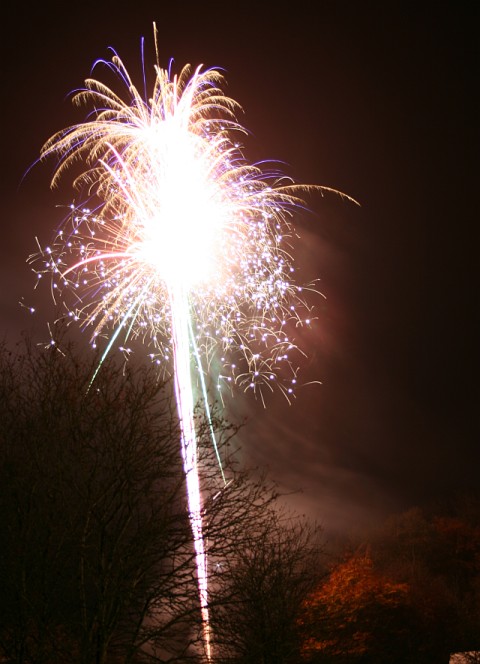
5 second exposure f4, 28mm zoom. A shorter exposure is compensated by allowing lots of light through the wide aperture, freezing some of the action of the firework (mainly due to the timing of the firework coming at the end of the exposure), but still catching a lot of reflected light on the trees below. One of my favourites
...
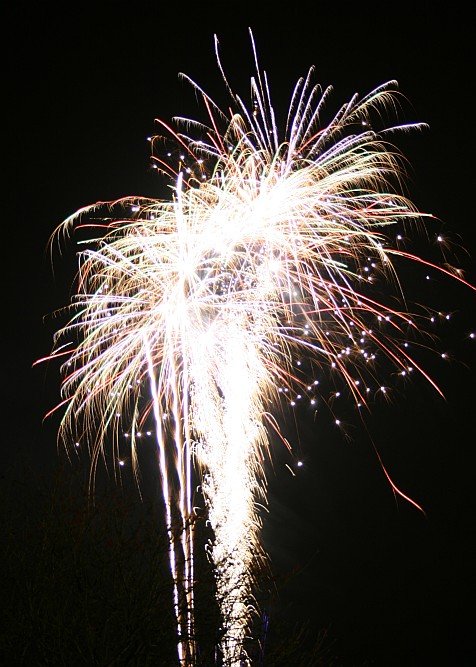
5 second exposure f5, 38mm zoom. More zoom, so closer than the previous shot, and aperture stopped down an extra stop. This halves the light entering the camera over the previous shot and makes the overall image considerably darker. Less foreground detail also contributes to this. A nice study but not much of an 'image'

...
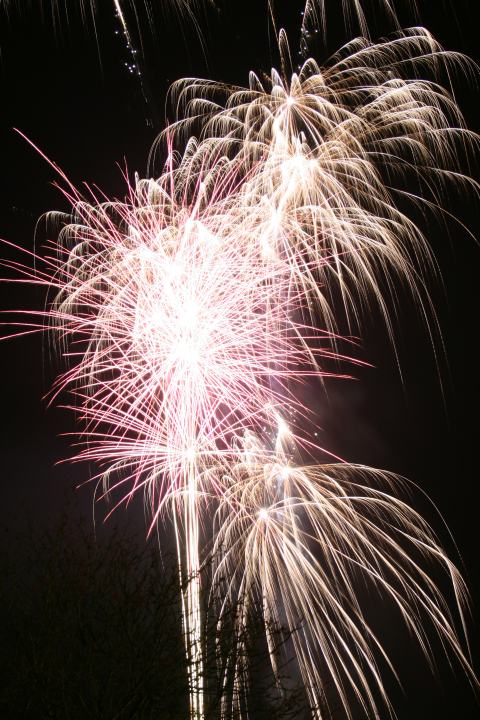
13 seconds f7.1, 38mm. Exposure increased to 13 seconds to and aperture stopped down (made smaller) to compensate for the increased amount of light allowed to enter the camera during the longer exposure. This has allowed more time to capture more fireworks in one shot

...
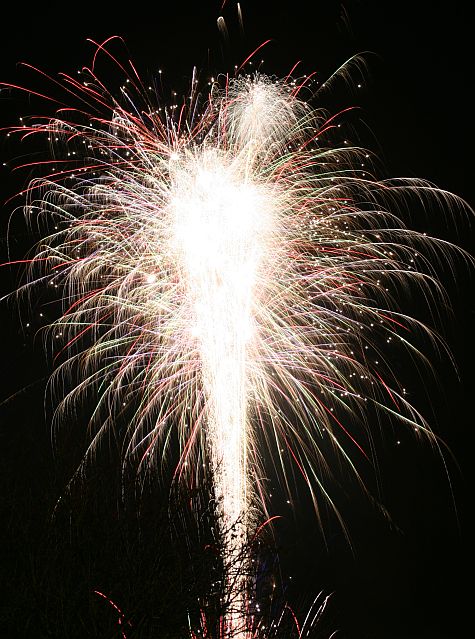
20 seconds, f10, 38mm. With the exposure increased to 20 seconds the camera has again stopped down the aperture to f10 to balance the amount of time light has to enter the camera, with the amount of light allowed through the lens

...
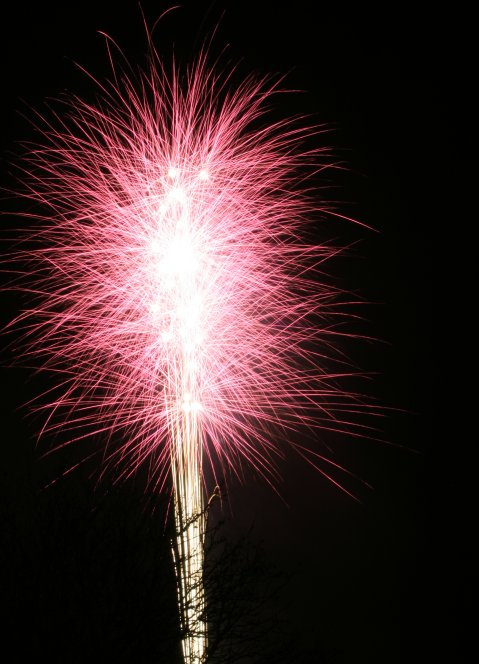
13 seconds, f22, 38mm. Ok, I have to admit, I think I was fiddling here and manually shifted the aperture down while choosing the shutter speed of 13 seconds.......either that or the camera light meter was fooled by light from a firework when I depressed the shutter so selected a very small aperture. However the 13 seconds exposure captured numerous small red pops and produced this, a very pleasing result

It's difficult to say what settings contributed to a particular effect, as the rate and size of the fireworks varied so much throughout the display, it does however show how longer exposures capture more ambient light, but can lose some of the detail due to higher volumes of fireworks combining in the one exposure.

Steve

 
IP Logged
 
Reply #1 - Nov 8th, 2007 at 6:57am

Roughrider   Offline
Colonel
Canon Rebel XTi (400D)
Pittsburgh, PA

Gender: male
Posts: 1123
*****
 
Great shots Steve, I like how you explain how each shots was done, great help in understanding whats going on. Thanks For Sharing, Mark
« Last Edit: Nov 8th, 2007 at 11:13am by Roughrider »  

...&&Canon Rebel XTi (400D)&&Canon EFS 17-85mm&&Canon EF 70-300mm&&Canon EF 100-400L
IP Logged
 
Reply #2 - Nov 8th, 2007 at 11:01am

Rifleman   Offline
Colonel
" Full size A/C are just
overgrown models ! "
Tropical island in the Pacific

Posts: 6622
*****
 
Fine shots here.......you've done well........ Cool

Night photography can be so rewarding .....when I started it, I was amazed by the things I got to see without anything more than sheer luck , but as you go you will soon get a feel for a starting point ..........for this kind of thing (fireworks) I would go to full manual and stay around f8 - f11 and a shutter speed of 30 seconds  with an ISO no higher than 200 ........the manual focus is the correct decision as it takes one more camera function out of the equation and should give less shutter lag....and yes, I use my remote on this all the time.........get one if you can ! On the other hand I do have a hand-held BEWI light meter to verify my settings and usually use it with an "incident" reading if I think I am getting too much light for a "reflected" reading......

This is only a starting point for me.....I make changes as I go......isn't the "now" part of digital photog great when you don't have to wait for processing to come back from the lab........ Wink

If you don't understand, I can elaborate, but don't have too much time at the moment. It's 0730 and leave for work soon.....  
 

...
IP Logged
 
Reply #3 - Nov 8th, 2007 at 11:04am

Willit Run   Offline
Colonel
Jack's Back!!
Cherry Hill, New Jersey USA

Posts: 4030
*****
 
Nice work!!!

These shots are great!!!!

Cory
 

...&&
IP Logged
 
Reply #4 - Nov 8th, 2007 at 4:31pm

61_OTU   Offline
Colonel
We are the Dead. Short
days ago.....
The Village - nr Shrewsbury

Gender: male
Posts: 1944
*****
 
Rifleman wrote on Nov 8th, 2007 at 11:01am:
Fine shots here.......you've done well........ Cool


Thanks Ken, I had my first attempt at firework photography last year with my Fuji, I went prepared this time  Grin

I used Manual a few weeks ago when taking pictures of the kids for the School calendar, set the aperture and shutter myself, and used the in-camera light meter to assess the light prior to a shot. I find the in-camera meter quite useful in this respect, you can use Av or Tv to get a rough idea of the suggested settings, dial it in manually, and use the light meter to ensure that not too much is changing in the ambient light from that point on. I got some much more consistent results this time around, which require virtually no changes to the white balance or levels in comparison to last year

Steve
 
IP Logged
 
Reply #5 - Nov 10th, 2007 at 7:31pm

Craig.   Offline
Colonel
Birmingham

Gender: male
Posts: 18590
*****
 
Great shots mate

P.S. I'll have my car fixed this week, so I should hopefully have you up in the loop testing out the new lense pretty much whenever your ready. Wink Smiley
 
IP Logged
 
Page Index Toggle Pages: 1
Send Topic Print