Search the archive:
YaBB - Yet another Bulletin Board


Page Index Toggle Pages: 1
Send Topic Print
High angle of attack (Read 309 times)
Sep 1st, 2004 at 5:19am

stevewilson   Offline
Colonel
Wish I had my pic here!
Hanford, Ca.

Gender: male
Posts: 445
*****
 
How does one fly a fighter at a high angle of attack? I know what it means, just don't know how to do it.

I've d/l the avro arrow, and the readme file recommends this on landing.
 

Steve&&&&CPU: Intel Pentium 4 519 3.06 GHz &&Memory: 512MB (256MBx2) DDR PC3200 (400MHz) DIMM &&Intel Graphics Media Accelerator 900 Graphics&&Motherboard: Intel Augsburg &&SATA 8MB Cache 160GB 7200 &&CD R/W ROM, DVD-R/RW&&1 CPU FAN, 1 ANTEC FAN&&300 W PSU, WITH FAN &&FS9/2002&&...
IP Logged
 
Reply #1 - Sep 1st, 2004 at 8:48am

garymbuska   Offline
Colonel
I would rather be flying
Jacksonville, Florida

Gender: male
Posts: 2850
*****
 
To fly any plane at a high angle of attack is asking for a stall, but one way to do it would be to slow down and keep back pressure on the controls. Another way would be to put extra weight in the rear so the plane becomes tail heavy. The only negative thing about this is as the angle increases so does the risk of a stall.  8)
 
IP Logged
 
Reply #2 - Sep 1st, 2004 at 10:54am

MIKE JG   Offline
Colonel
Gravity Always Wins...
Ohio

Posts: 845
*****
 
Flying at high AOA's requires the pilot to find a balance between lift and drag.  The higher you make the AOA using pitch commands, the more you increase the lift.  But in doing so you also create more overall drag on the aircraft, induced drag from the production of lift and just more overall drag from the aircraft itself as you expose more of it's "body" to the relative wind of the airstream.  So to fly at a high AOA you must balance the larger AOA with more thrust.  

Try this.  All student pilots from Cessna's to fighters are taught to perform slow flight.  To do this begin by reducing the power to idle.  As the speed slows the aircraft will want to descend.  Resist the descent by ever so slightly increasing the pitch.  Continue to very slowly increase the pitch to fight the descent. Eventually at the slower speeds you will need to re-introduce power to maintain your altitude.

Just keep adding power in very small incriments to fight the descent while increasing the pitch to fight the descent as well as control the speed.  Once the aircraft is in true slow flight your pitch angle wil control your airspeed while your power will control your altitude.

Here are a couple of shots (Moderators:  not sure if this is allowed in this forum but it helps the disscussion) of Kirk Olsson's Viper transitioning to high AOA/slow flight.

First:  Straight and level with power at idle.
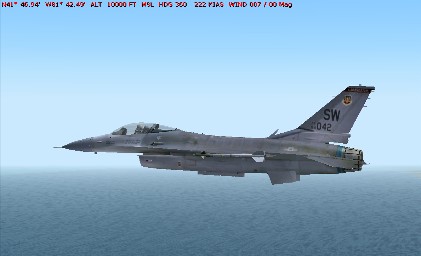
...
Next:  First segment of flaps 150 kts.  Pitch is about 12-15 degrees and power just above idle.  To get down to this speed initially you have to use the speed brakes.  Jets don't like to slow down.
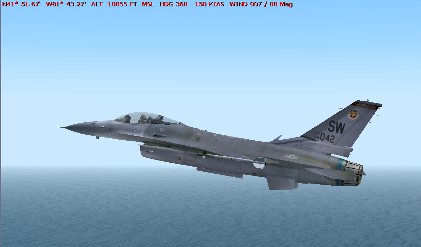
...
Next:  Full flaps 100 kts.  Pitch is about 17-20 degrees nose up, power at about 25%.
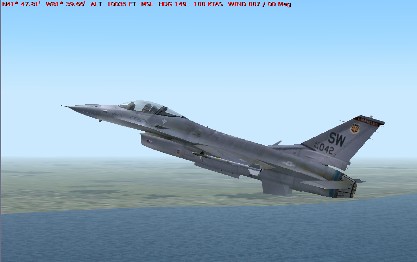
...
Finally:  Full flaps and gear 110 kts.  Just about the same pitch as without the gear and just a little more power to hold level flight.
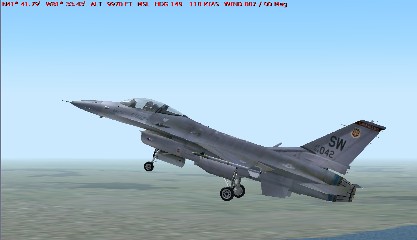
...

Kirk's Viper is the only fighter that I can do this with.  The others just won't cooperate so I don't know how well it can be done with the Avro.

So practice this and then translate it to the landing where you should get something like this.  

A nice stabilized approach at about 130 knots or so for the F-16 with an appropriate rate of descent for landing.
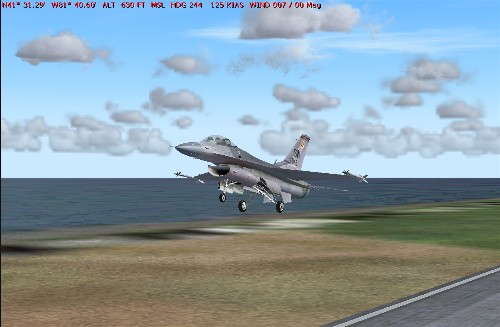
...

Just hold it all the way to the ground with just a little flare at the very end.
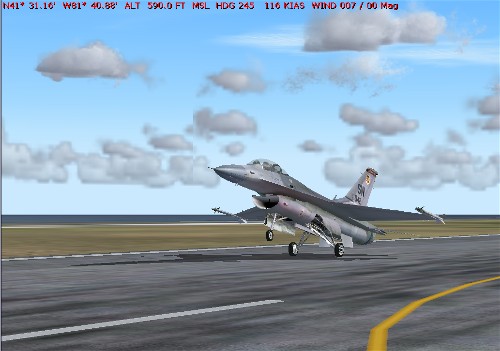
...

Good luck.

« Last Edit: Oct 21st, 2004 at 9:22pm by MIKE JG »  

-Mike G.

...

Military AI traffic packages and scenery for the Microsoft Flight Simulator series.
IP Logged
 
Reply #3 - Sep 1st, 2004 at 11:09am

codered   Offline
Colonel
Flight Plan Closed?

Posts: 1622
*****
 
slow flight is the best part about flight training.  I learned to do it in a Cessna 152 and a Piper Warrior.  We would slow the aircraft down and set the trim to hold just above stall speed, while maintaining our altitude.  Then with very slight inputs on the controls you can make turns, etc.  Flying on the back side of the envelope is great.  It is just like hanging out at 3000'.
The only anoying part was the stall horn blaring at you. Grin 

That is one thing that I noticed in FS9, the stall horn goes off and you immediatly stall.  In a real aircraft the stall horn is a warning that the aircraft could stall if you don't change what the aircraft is doing.
 

Windows XP SP1&&Motherboard: Epox 8RDA + main board&&Processor: AMD XP2500 Barton CPU&&Memory: PC2700 1gb Geil DDR&&Hard Drive: SEA HDD IDE 40GB 7M 40GPP&&Hard Drive: Western Digital 40gb 8mb cache&&Monitor 15 LCD Flat Panel Display (15 viewable)&&Video Card: ATI Radeon 9500 Pro&&Sound Card: Creative Labs Audigy 2
IP Logged
 
Reply #4 - Sep 1st, 2004 at 11:15am

MIKE JG   Offline
Colonel
Gravity Always Wins...
Ohio

Posts: 845
*****
 
Quote:
That is one thing that I noticed in FS9, the stall horn goes off and you immediatly stall.  In a real aircraft the stall horn is a warning that the aircraft could stall if you don't change what the aircraft is doing.


Yea that's one area where they (Microsoft) could do some work to make it better.
 

-Mike G.

...

Military AI traffic packages and scenery for the Microsoft Flight Simulator series.
IP Logged
 
Reply #5 - Sep 1st, 2004 at 5:02pm

stevewilson   Offline
Colonel
Wish I had my pic here!
Hanford, Ca.

Gender: male
Posts: 445
*****
 
Thanks guys.  I'll have to take the avro up to high alt' and practice.

The avro starts falling like a rock when below 170k, so far I haven't been able to land it w/out over stressing the gear.
 

Steve&&&&CPU: Intel Pentium 4 519 3.06 GHz &&Memory: 512MB (256MBx2) DDR PC3200 (400MHz) DIMM &&Intel Graphics Media Accelerator 900 Graphics&&Motherboard: Intel Augsburg &&SATA 8MB Cache 160GB 7200 &&CD R/W ROM, DVD-R/RW&&1 CPU FAN, 1 ANTEC FAN&&300 W PSU, WITH FAN &&FS9/2002&&...
IP Logged
 
Page Index Toggle Pages: 1
Send Topic Print